
A research team from the Institute of Metal Research (IMR) of the Chinese Academy of Sciences has developed an efficient, stable, atomic-scale catalyst for carbon monoxide (CO) oxidation. This advance offers promising strategies for environmental catalysis and designing low-cost, high-performance catalysts.
The study, published as a cover article in Nano-Micro Letters on January 5, addresses a long-standing challenge in catalysis.
Although single-atom catalysts maximize the use of precious metals, they often struggle to activate multiple reactants, such as CO and oxygen (O₂), simultaneously. To address this issue, the IMR team, led by Profs. LIU Hongyang and SUN Bo in collaboration with Chongqing University, constructed a catalyst featuring atomically dispersed platinum-ruthenium (Pt-Ru) pairs anchored on defective graphene.
Using a straightforward co-impregnation method, the researchers constructed stable Pt-Ru dual-atom active sites. Advanced characterization techniques confirmed the formation of a direct Pt-Ru bond. This bonding interaction enhanced the metallic nature of both atoms, enabling them to work in synergy.
During the reaction, CO preferentially adsorbs to the Pt atom, while O₂ is effectively activated at the bridging site between the Pt and Ru atoms. This cooperative action overcomes the competitive adsorption limitation of single-atom catalysts and dramatically reduces the energy barrier for the reaction.
The resulting catalyst, designated Pt₁Ru₁/ND@G, exhibits exceptional performance. At a low temperature of 30 °C, it achieves a CO oxidation turnover frequency (TOF) of 17.6 × 10⁻² s⁻¹. This value is ten times higher than that of a comparable platinum single-atom catalyst and surpasses the performance of most previously reported platinum-based catalysts. Furthermore, the catalyst demonstrated stable activity during a 40-hour continuous test at 80 °C, showcasing its durability.
This work provides an efficient synthesis strategy for dual-atom catalysts and offers fundamental insights into their synergistic reaction mechanisms at the atomic level. It opens new avenues for designing next-generation, atomically precise catalysts for critical environmental and energy applications.
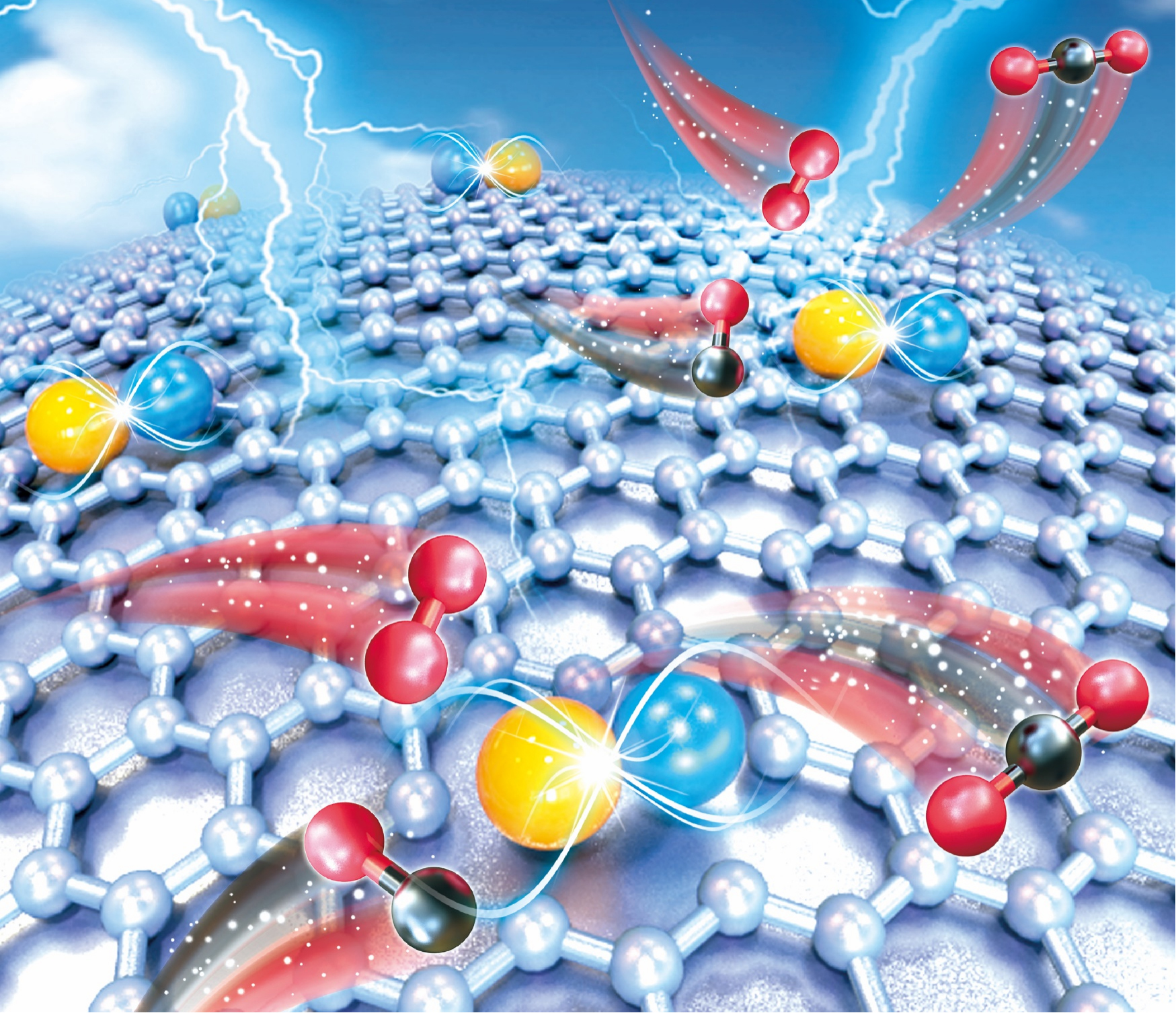
Schematic illustration of the CO oxidation reaction catalyzed by Pt₁Ru₁/ND@G. (Image by IMR)
Scientists at the Dalian Institute of Chemical Physics have developed completely coke-resistant Ni-based single-atom catalyst (SAC). Their finding may provide a new approach for the development of highly coke-resistant Ni-based catalsyts and facilitate their commercializa...
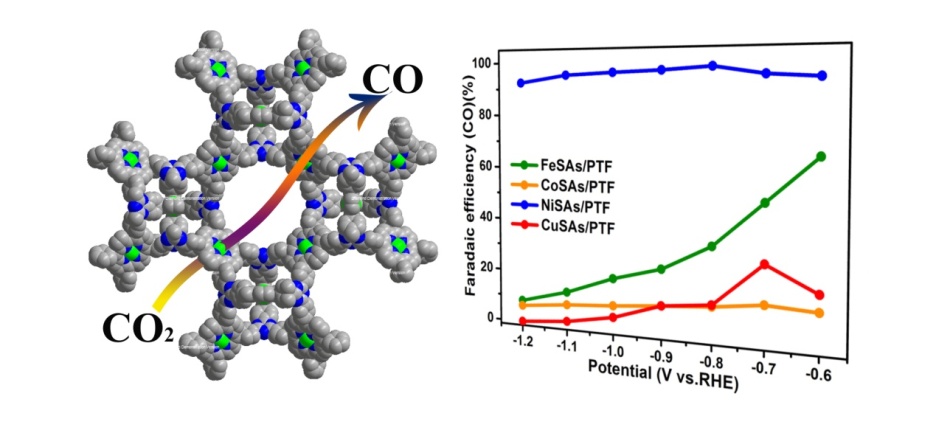
The research team from Fujian Institute of Research on the Structure of Matter unraveled the trends in the reactivity and selectivity of atomically isolated M-N4 (M = Ni, Cu, Fe, and Co) sites within porous porphyrinic triazine framework (MSAs/PTF) for the electroreductio...

86-10-68597521 (day)
86-10-68597289 (night)

52 Sanlihe Rd., Xicheng District,
Beijing, China (100864)
Copyright © 2002 - Chinese Academy of Sciences


